
Languages Settings and Usage
Watchers solution is fully localised into all needed languages. Also, we provide a feature for automatic translation of messages.
We have a list of ready languages for the chat interface; you can set any of them as the main or an extra language. To change the active language for users, you need to send us a GET parameter. Automatic translation for users and moderators is available and must be turned on. All placeholders for different chat interfaces can also be translated into all needed languages manually or automatically.
Interface Language

When you launch a chat, you need to pick a default language. Whether your platform supports one language or many, you must choose the main language for the chat.
We have a list of available languages; you can choose one through the admin panel (Settings > Language and localisation). If you cannot find the language you need on the list, contact your Watchers’ manager.


Then, select all additional languages if suitable.
These selected languages will be activated with the GET parameter transfer.
If you can't find the needed language on the list, connect with your Watchers' manager.
Automatic Translation of messages
There are two automatic translation tools for chat messages: one for users in the chat interface and another for admins and moderators in the admin panel.
Automatic Translation of messages for users
If your users are from different countries or multilingual regions, you can enable automatic translation. When enabled, this tool allows users to select the language in which they want to read messages. All messages will be translated into the selected language for that user.
Users can disable this feature or change their preferred language at any time.
How can this tool be activated for users through the admin panel?
Open the Language and Localisation section.

This feature operates on a pay-per-use basis. You must confirm that you have been informed of this before enabling it.
How can users change the language
- on the chat with the specific button
- on their personal settings in a chat


Automatic Translation of messages for admins and moderators
Admins and other admin panel users can enable automatic translation for messages in a room. To do so, open the room, click the control button in the upper-right corner, and enable the appropriate toggle. Then, select the desired language.
When automatic translation is no longer needed, disable it using the same toggle.

Additional texts and placeholders
Chat placeholder, greeting messages, chat rules, and states of a room.
Chat Placeholder
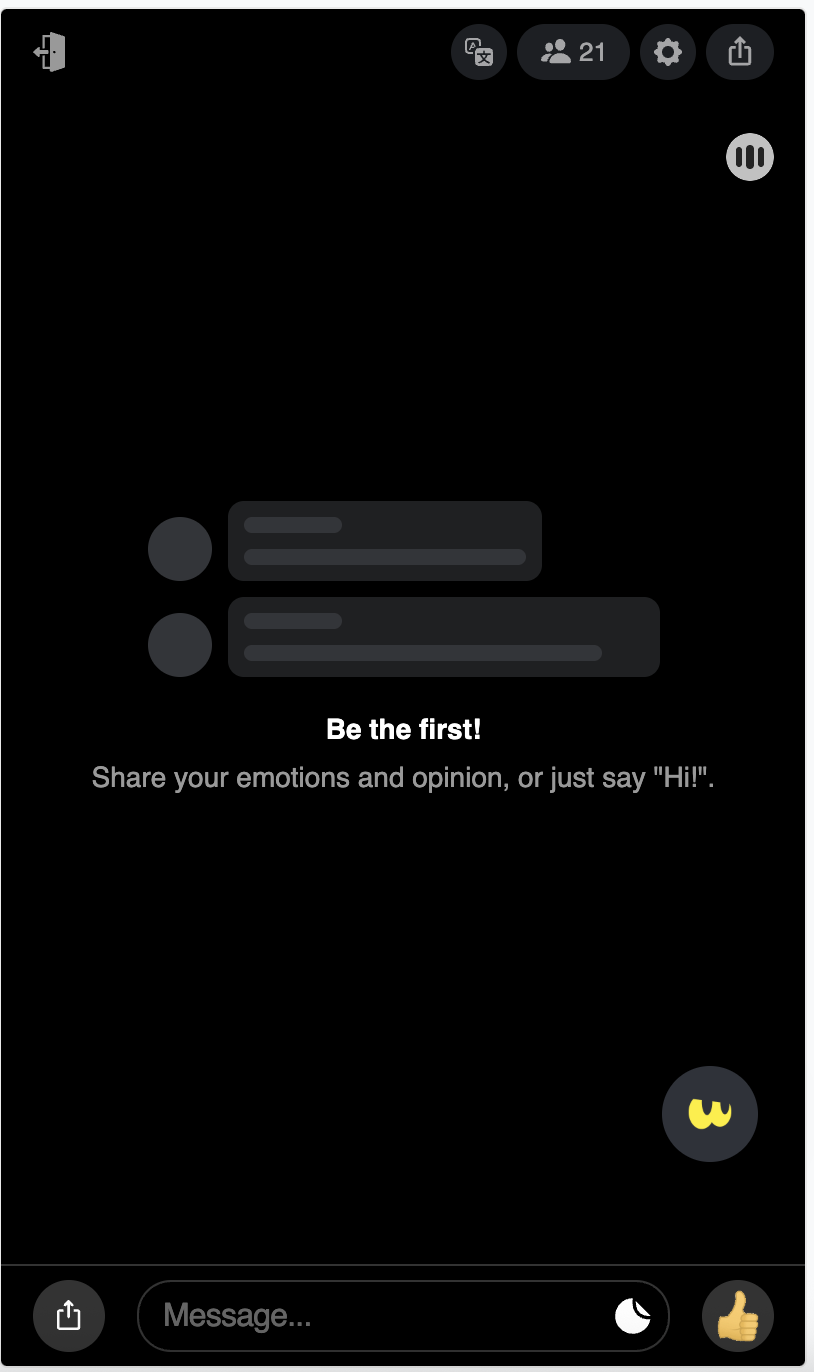
The text is visible to users in empty chats. This placeholder is important if you have many event rooms on your platform. If you have one single room, your users won't see this text after the first message appears.
You can add variants of this text in all the languages you need or translate the first one with automated tools. After translation, you can correct them; just correct and click Save. You can change all this text any time you need.
You can add placeholder localisation for those languages you have already activated in the first tab of the Language and Localisation section.

Chat Rules
Chat rules are visible to users in personal settings and through a link when they are banned. Make these rules visible and localise them in all required languages. Select all languages in the Language and Localisation section// the first tab. After this, new language tabs appear.
There are two sections on the Chat rules page.
The first section is for the text that users see when they accept the default short chat rules while joining chat for the first time. You can add links to additional documents that users must accept.
The second section is for the Chat Rules themselves. These chat rules can contain only text. You can edit their layout.


States of a chat room
When you schedule rooms, your users see when the room starts and finishes. Edit these texts to specify what users expect and why the room is closed right now. Pay attention to the language tabs and ensure you have activated all needed languages, and use automated translation if needed.

Localisation of the engagement widgets
You can localise all engagement facilities in a chat to activated languages, manually or with automated translation. Pick the needed languages on the list in the Language and Localisation section, and language tabs will appear for all widgets.
You can add texts there manually, or add only a main language and translate it to other languages with automated translation. You can correct these translations if needed.
Copy and social widgets are localised automatically with the switching of languages on the user interface (via transferring a GET parameter to us).
